24 August 2006

the sorrows of the soda-pop expatriate


These are difficult days for the Soda-pop Expatriate. After many years abroad, he has returned to America with a diminished view of the way his favorite beverage is perceived around the world. The Yankee-friendly exuberance of the 1950s has finally fizzled out, and Coca-Cola is no longer politically popular. In fact, it has served as a scapegoat for many greater health and societal ills around the world. Obese New Delhians credit cola with their ungainly gains in girth. Rural Guatemalans blame the products for a spike in Diabetes cases. Many European universities have launched a boycott on Coke products on their campuses, determined to throw off the yoke of what they refer to as "carbonated imperialism."

At home as well, there are soda woes aplenty. Mr. Pibb has been stripped of his manhood, and is now referred to as Pibb Xtra (it's the extra that gets him every time). Mello Yello, the tired hippie, is not so much mellow as she is jaundiced. Elementary schools are considering removing pop machines from cafeterias in favor of less-fattening options. Across the country, thousands of health fanatics underdose on Cola every day.

Finally, the Soda-pop Expatriate's personal life is not what it used to be. Rather than spend his afternoons cruising down small highways at 120 km-per-hour with the windows open and a 44oz fountain drink in his hand, he instead drinks several paper cups of third-rate coffee each morning within the air-conditioned sterility of an office tower. Thanks to recent weight gains, holes in his teeth and several unsightly stains on his Siberian bearskin rug, even the Soda-Pop Expatriate is doing his best to kick the habit.

But it isn't easy. In the same way recovering addict musicians quit playing certain kinds of music because they associate it with drugs, the repatriated Soda-pop Expatriate is not quite sure what other concessions will need to be made in order to make a clean break. Naturally, some compromises are in order. So far, he has decided only to drink Coke on lunar holidays, on trips to the beach and whenever he goes out to eat Mexican food. And at lunch. Still, many emotional and physiological attachments to high-fructose corn syrup-flavored carbonated beverages remain.

Recently, he wrote this speech on the occasion of his one-night anniversary of not drinking any soda. It is addressed to the Soda Goddess, and is included exclusively here for your reading enjoyment.


Goodbye, Cola
by the Soda-pop Expatriate

Oh, opaque liquid

Your syrupy presence in my stomach
was always a comforting discomfort

Years ago, I went on Paul Revere's midnight bike ride for cola

searching for
the blinking beacon
of vending machines
stacked on top of each another

1 if by land
2 if by sea
3 if by air
4 if by dream

Now I will try to live without your carbonation
And I must admit, I feel lighter now
without your bubbles in my system

Lighter, but somehow less tied
to this gas-station covered landscape

where the endless soda
fountains of youth
spill over and
over and over

22 August 2006

15 August 2006

All I never needed to know I learned from...

It's Never o'clock in Kansas City, and somewhere Midtown's most enigmatic graffiti artist is leaving his mark on the neighborhood.

His name is Neverino, and no one knows where he comes from. I first saw the name "Neverino" painted on a square of sidewalk near my apartment, and I found it funny enough to invent a backstory. Neverino, I surmised, was a little boy of either Hispanic or Italian descent who was struck and killed by the "Little Bastard" (the same Porsche 550 Spyder James Dean was driving when he died) at the bus stop on 43rd & Main. Now the listless spirit of the boy roams on, unable to communicate with the waking world except through spraypaint and paintmarkers.

I liked this story so much that I began to believe it, even inventing a cutesy, Spanish-sounding voice for Neverino that I often used while talking on the telephone. Soon, however, I began to realize that Neverino was a bigger phenomenon than I had imagined. I started to see variations on the Neverino name on signs and buildings around the neighborhood. A giant "Never" appeared on the back of a Broadway st. billboard. One Sunday, I even noticed that my mailbox had been tagged by a certain "Mr. Neverino." Almost overnight, Never was everywhere.

It was almost scary, the way Never always seemed to be just a few steps behind or ahead of my own urban adventures. In a parking lot down the street from the prostitute-frequented QuikTrip on Troost, I discovered a pair of Toys'R'Us truck trailers, only to see that Neverino had left his mark. Just two days after I took a photo-snapping tour of the Mission Mall ruins, I drove by to see that Never and his associates had written their names on the eastern face of the building. This act in particular demonstrated a boldness that astounded even me. Not only had he canvassed Kansas City, Missouri -- the long arm of Neverino could also reach into Kansas.

I thought and thought about a time that our paths might have crossed, but couldn't seem to come up with one. If I had seen Neverino, I hadn't known it. Still, I can't help but feel like I've gotten to know him at least a little bit through his artwork. A few of the things I've learned about Never:

• He has a playful sense of humor. Next to the giraffe on the aforementioned truck trailer, he wrote: "Neverino: I'm a Toys'R'Us kid."

• He is a night owl. On a giant, bubbly series of purple-and-green tags on the back of the Berbiglia liquor store, he wrote "It's 4 in the morning and it feels like spring."

• He is well-versed in history. Another tag near the liquor store reads "the home of the Nevercaneezer," a reference to Nebuchadnezzar, the ruler of Babylon who built the hanging gardens in 600 B.C. as an ersatz tropical paradise for his homesick wife, Amyitis.

• He is physically daring. Even a phantom would have difficulty scaling the heights Never must reach to complete his tags.

Because these observations shed little light on Neverino's personal life, it may be more worthwhile to take a look at the linguistic impact Neverino's marker has made on the community. Under Neverino's semantic makeover of Midtown, The Kansas City Star becomes The Never, and the Pitch changes from a weekly to a (you guessed it) never. 43rd & Bell becomes 43rd & Never. A nearby sign reads "Do Not Never Enter" and a simple red stop sign becomes a bright octagon of motivation. Local business hours either never end or never begin.

A first-time visitor to this ethnically diverse region of Kansas City might easily look around and declare himself in never-never land. Not surprisingly, the local police force is not amused. One afternoon, while snapping one of the very photographs displayed here, I noticed that I was being observed by a member of the KCPD. Though he eyed me dubiously, I think even he could tell that I was but a documentarian; a humble custodian of Never's legend and not its elusive author.

Just when I was reverting back to my original beliefs that Neverino was a specter invisible to the human eye, I heard a report on my police scanner that two officers had cornered a young male with a spraypaint can at the side of the Seville Best Western, just a block away. I dropped my harmonica and hard lemonade and raced to the scene as fast as my legs could carry me. From behind a dumpster I saw the officers closing in on the shadowy figure (Neverino, I presumed). The officers brandished their nightsticks, and one of them shouted, "Everything will be a lot easier if you just drop that spraypaint!" With a sudden hiss, a great purple cloud engulfed the three of them, causing the officers to lose sight of their suspect and start coughing. When they finally succeeded in waving the cloud away, the culprit had vanished, leaving his one-word response on the wall:


I know it may be a bit hard to believe, and believe me, I wish I was joking. I thought the superstitious phase of my life was over, that my days of peddling ghost stories had ended with my last weeks at summer camp. But I'm afraid Neverino has extended my belief in these matters indefinitely. Should I ever be in danger of losing my faith in the spraypaint-supernatural, I'm sure a fresh tag from Never will be there to make sure I never do.

08 August 2006

Arthur Lee, 1945-2006

As a tribute to the recently departed frontman of the sixties band Love, I'm going to include my own short review of the Arthur Lee concert I attended at the CMJ music festival in October 2003, when I represented KJHK Lawrence as the jazz director. The piece is part of a greater CMJ journal I kept for "No Radio" issue 2, which never really saw print. Might as well share it now.

A grainy photo of Arthur Lee (on the far left) shourded in mystery.

Love with Arthur Lee, live at the Warsaw Ballroom 8/23/03

"...If nothing else, the steep price of suds in Brooklyn kept me sober enough to find my way to the Warsaw Ballroom for the Love with Arthur Lee show that night. For those of you who weren't somewhere between Clark & Hilldale circa 1966, Love was the Los Angeles psychedelic outfit who were imitated in sound by the Doors and in style by Hendrix. In fact, if you listen to the claims of Lee, the self-professed "first black hippie," Love was imitated in everything by just about everybody. If you listen to his music, however, Lee's claims begin to sound plausible.

The extravagant, out-of-the-way Warsaw Ballroom made an apt setting for the event. Elaborate murals flanked the stages, and Zwyiec beer was sold in several locations. I saw more gay couples and older fans than college radio-heads, and as snobby as it sounds, it was nice to be around a crowd of people who knew Love's music from something other than the Inez/Luke Wilson motel love scene in "Bottle Rocket." Though Love's contributions are widely recognized today, the pre-concert atmosphere still held the thrill of an underground sensation.

After much adjusting of microphones and music stands, Lee and band began with "Your Mind and We Belong Together," the swaggering outtake from Love's 1967 masterpiece, "Forever Changes." Right away, the band's arsenal of trumpets, flute and a string quartet were unleashed to the fullest effect. Lee sported a colorful bandana under a black hat, only removing his sunglasses for 15 seconds of the whole performance. Lee remained animated the whole time, smiling, playing guitar and harmonica and even breaking into a jig later in the set. There were moments I could have sworn he was barely out of his twenties.

The set also featured a good representation of songs by Bryan MacLean, the late guitarist whose flamenco-inspired style gave Love much of its baroque sound. MacLean's "Orange Skies" is the day-dreamiest number on any Love album, and his composition "Alone Again/Or" (you know, the one with the lyrics "I think that people are the greatest fun") has all but become Love's signature song. The rest of the set ranged from Burt Bacharach's "Little Red Book," to "Rainbow in the Storm," a new song which Lee also announced would be the title of an upcoming autobiography.

Though it took him a few songs to warm up, Lee sang forcefully and convincingly, giving his lyrics a light-hearted lilt at some times and an ominous emphasis at others. Lee's lyrics have always sounded more prophetic than political, and seemed eerily relevant throughout the show. When this version of Love (which features no original members other than Lee) played "The Red Telephone" -- a reference to the president's direct office line -- the band stirred the song into a frenzy while Lee screamed, "I want my freedom!" Lee has a special claim to this phrase, having served seven years for weapons charges before a judge overturned his stentence in 2001.

Listening to something haunting from the past is one thing, but seeing it come alive this convincingly was stirring, to say the least. By the time Lee asked the crowd "Why does this feel like a historical event?" it sounded like a rhetorical question. "What's cooler than being cool?" asks the recent hit single by Outkast. Even in 2003, the answer was still Arthur Lee..."

Update: While checking a song title on All Music Guide just now, I saw their multi-authored write-up about Love's music. Worth reading, even though there's still no substitute for hearing it yourself.

The storm has passed, the rainbow remains.

03 August 2006

29 July 2006

Goodbye, Gloo

When I say "Goodbye, Gloo," it might sound like the sentiment of a teenager swearing off his favorite classroom inhalant, but I assure you I'm speaking of something many times larger and much more intoxicating.

By Gloo, I mean Igloo, the hut in the backyard of the house my girlfriend and friends rented in Lawrence this past year. The Igloo -- which has also been referred to as the Flinstone House, the Smoking Hut, or the Home-Away-From-Home -- is a structure the owners apparently built for their grandchildren to play in.

For such a whimsical little thing, the Igloo's architecture is rather impressive. The walls are built of some kind of adobe resting on a base of half-buried car tires. A number of open arched windows and about a half-dozen glass bottles built into the wall provide mini-shelves and a place for light to shine through. There used to be a Chiefs helmet perched on the roof, but that has since fallen to the ground.

As my friends prepare to move out of the house, a rush of memorable Igloo moments comes back to me.

The first event that really put the Igloo on the map was a taping of a Turnpike episode that featured the band Ghosty (bassist Mike Nolte is one of the house's residents). Host Tim Van Holten and his crew crammed everyone into the cramped quarters for the interview section of the show, which the show's producers tried to depict as taking place on the Dagobah system. Afterwards I planned to conduct a series of Native American purification rituals to counterbalance the exploitation of what I consider a sacred structure, but because I'm not Native American and don't know any rituals, I instead initiated an Igloo hanging-out campaign that went on for many moons. And what marvelous moons they were.

The Igloo wound up being a great destination for impromptu afterhours, especially when a friend or two visited from out of town. With a group of people seated on the benches and a communal 12-pack of PBR in the middle, it was sort of like visiting our caveman roots without even leaving the backyard. For Jennifer’s birthday that summer, we held a backyard barbecue, with the Flinstone House serving as kind of a prehistoric V.I.P. lounge.

More than once, the Igloo served as a getaway from the outside world. On the night of April 30, during the height of her roommates' obsession with "Lost" DVDs, Jennifer and I decided to seek shelter there. While a thunderstorm raged, we lit a few candles, shared a bottle of wine, and did our best to celebrate the old pagan festival of spring known as Walpurgisnacht. Though the wind did little to chill us, it did make the candles flicker so that they occasionally looked like blinking emergency lights.

Thanks to its cramped space and primitive design, the Gloo has an extraordinary effectiveness in bringing out the important things in life. In the same way that the mind is sometimes called a reducing valve for the world (or "mind-at-large"), the Igloo operates as a sort of reducing valve for life in Lawrence, boiling down the city as a whole to what I consider its essential elements: good people, interesting conversation, and the occasional intoxicant.

But for all the times there’s been a fun Igloo hangout session with friends, I’ve spent equally enjoyable time there alone. Like the stormy night I sat until 4 in the morning with a pen and a pad writing absolutely nothing. Or the early morning I went out to the Igloo to record some banjo music but wound up deciding to document bird songs instead. Or the Sunday afternoons I couldn’t think of anything else to do in town but hide out in the hut and listen to music.

Eventually, either the original owners or someone else will move back into the property and make use of the Igloo in whatever way they see fit. But for now, it is likely to be taken over by the abundant locust shells that we’ve periodically swept off the walls. In fact, at the aforementioned birthday party, acclaimed photographer and birthday-cake designer Tara Sloan plucked a locust shell from the Igloo and set it upon the back of the tiny decorative llama she used to decorate the cake. Tara was so amused with her creation that she set it up in the windowsill above the kitchen sink.

With the pots and pans, furniture and house residents disappearing around it, this mini-sculpture only grows more poignant: A locust shell riding a motionless toy llama on the windowsill of a beautiful, soon-to-be-vacated bungalow in Lawrence, Kansas. Sad and bizarre, yet somehow I can relate.

Yesterday I drank a beer inside the Igloo for the last time. Today Jennifer, Mike and Carmen will remove the last bit of furniture and cat hair from the Vermont St. House/Flinstone House complex. Before I get too choked-up saying goodbye to the Igloo and this period of my life, I'd like to make a final blessing: May the Great Spirit watch over the Igloo, and may the spirit of our great times there live on.

(photos taken by Jenn, oil pastel drawing by me)

27 July 2006

Hello, tortoise

A story of magical animals and staying up late

PART 1
The other night, I heard the squall of the stray tabby cat that hangs out around my back staircase. That is nothing new, but this time I heard something different in the cat's voice that caused me to step out back and see what was the matter.

To my surprise, a multicolored tortoise was perched on the back deck, with the orange kitty circling it cautiously. The tortoise's shell was giving off lights of many colors, which I assumed was just the reflection from the flashlight I always carry with me in the late evening hours.

Being a kind and hospitable soul, I held the door open slightly, allowing the tortoise to make its way inside. My visiting friend Andrew Giessel, a Harvard man, came to get a closer view of the specimen, and we took turns examining it and turning it around gently in the palm of our hands.

It was a fascinating creature!

PART 2
While making what he assumed would be one-sided small talk with the animal, which did not appear to be native to Jackson County, Missouri, Giessel discovered that the shimmering lights on the tortoise's shell were arranging to form messages. Astounding! The tortoise told us her name was Cassiopeia, and that she could see 30 minutes into the future.

Then I realized: of course! This was the magical tortoise from "Neverending Story" author Michael Ende's classic book, Momo. Unlike Cassandra, the similarly named ancient Grecian times who was doomed to see the future but never be believed, Cassiopeia the Tortoise's suggestions were always heeded by Momo in her quest to save the hour-lilies from the nefarious Men in Grey.

PART 3
The three of us stayed up until early in the morning, talking about all kinds of things. We talked about Camillo Golgi's discovery that staining nervous cells with silver ions can allow humans to see neurons, a fascinating process called the "black reaction" that scientests don't fully understand even today. We talked about balancing creative endeavors with full-time employment, and the importance of bringing good ideas to life rather than letting them stagnate and disappear in the back catalogs of the brain. We talked about Jose Gonzales, and how strange it is that a Scandinavian musician would have such a Mexican-sounding last name.

In fact, Giessel and I got so carried away in our conversation that we didn't even notice our friend had disappeared until we heard mysteriously melodic tones from inside the apartment. Turns out the tortoise was a wicked hand with the Fender Rhodes, and an especially big fan of Ramsey Lewis. Who knew!

AFTERMATH:

We listened to the tortoise play tunes on the softly amplified piano, drinking several of the fine microbrews I keep in the icebox for such occasions. At one point, during an especially soulful number, I asked Cassiopiea "What's the secret, tortoise?" Instantly, the words "More Haste, Less Speed" appeared on its shell. We took this as an endorsement of its tasteful but not show-offy playing style, as a variation of the old Chelonian "slow and steady" mantra, and as a suggestion that "it's not the fastest way from point A to point B that you should take, it's the best way."

We sat on the floor and listened until the songs and lights from the tortoise drew us into a sleeplike trance. When we awoke, we realized that Cassiopiea was but an inanimate garden ornament I had purchased the day before at Midwest Surplus in North Lawrence for $7.99, and that this wishful account was really just another delusional blog post sleepwritten at the late hour of 3:26 AM.

The book, however, is real, and much more imaginative and spiritually rewarding than just about any story out there. Those more interested in Momo can check out the Wikipedia article about her, and even read the entire text in English on this Russian site, although buying a used copy of the book and sharing it with others is much more fun.

21 July 2006

bush pilot, was hast du getan?

By now, many of you have probably seen the grainy video footage of German Chancellor Angela Merkel quickly rebuffing George Bush's awkward attempt to give her a neck massage at a global summit. If you haven't, there are YouTube vids aplenty depicting this embarassing scene.

The maneuver has been jokingly referred to as a "sex attack" in the blogosphere, but few folks have actually delved deep enough to learn the real reasons Bush did what he did. Fortunately, and with a little help from the foreign press, I think I may have figured it out.

The answer, oddly enough, can be found in an amazing video report done by German news network NDR some time ago. I'm not generally a fan of circulating Bush-related humor, for the simple fact that there is so much of it and it's all rather depressing once you stop laughing and realize he is our elected leader. However, the "Bush Pilot" feature is a cut above the rest.

My theory is that the "Bush Pilot" (also known as Johannes Schlüter) has been pent up in the "Kopfpit" for much too long now, and couldn't resist showing some physical affection for the female leader of his home nation. To see the NDR clip about the Bush Pilot with English subtitles, klicken sie bitte mal hier.

07 July 2006

haikus and pictures, July 1-6

Monument, Colorado

Cop ahead, go slow
the road to the trailer park
rife with alfalfa

Denver

Yesterday's okays
from paper politicians
who have lost their hands

Horseshoe Tavern, Hays, KS

cycle, leather, gun
and my dog in the basket
what more could I want?

Vine Street, Hays

Al's Chickenette
where a salad consists of
iceberg and crackers

Colorado Springs

giraffe in brown pants
why's he wear red suspenders?
to keep his pants up

Circle 8 Motel

the soda motto
that will be carved on my grave
"drink Coke, play again"

Cripple Creek valley

Driving my white bus
over the mountains and through
the schoolgrounds of sludge

Cripple Creek heights

strip-mined mountainsides
like a Tower of Babble
that's built in reverse

the old mine

lightbeams piercing through
the holes in my blacksmith's shack
now it's not so black

Golden Gate Canyon State Park

1828
The home of Anders Tallman
forgotten valley

music business

G.B.'s record store
Jacob Baum bought music here
when he was a child

Joplin, France

giant Jennybros
girlzilla in a striped dress
in la tour eiffel

26 June 2006

follow-ups

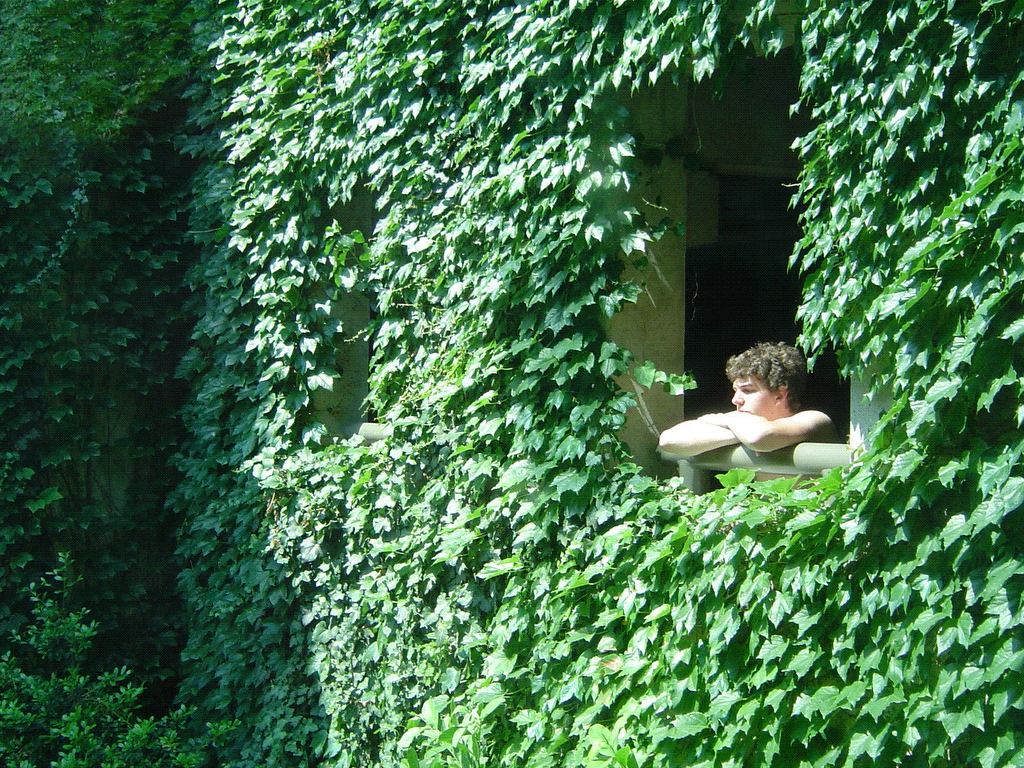
I'll start with the good news first. Jennifer's photo of some guy looking out a window in an ivy-covered parking garage was the runner-up in the Urban Photo Safari Contest, which 25 photographers or teams took part in. There are a lot of good photos on the contestant site that provide a neat view of Kansas City landmarks.

In sad news, I received word today that the brown bear named JJ1, or "Bruno" as he has been referred to by the European press, has been killed. Politicians and animal lovers alike were upset by the outcome. According to Yahoo! News, Tony Scherer, the mayor of Schliersee, the Bavarian town near Spitzingsee lake, where Bruno was killed, disagreed with the actions.

"The death penalty has been abolished," Scherer said. "This bear didn't do anything bad — for me it is absolutely unnecessary for him to have been shot."

I first wrote about Bruno on this site several weeks ago, excitedly suggesting that JJ1's adventures would make great fodder for a song, screenplay or poem. However, I can't say I didn't anticipate a tragic end to the saga. As usual, society and squeamish sheep farmers are to blame. However, I also hold the media partially responsible. The media's chosen nickname of "Bruno" invokes the unpleasant traits of brutality, belligerence, as well as the name of Popeye's nemesis. Bruno also suffers an unfortunate association with another tragic German figure, Bruno S. Bruno S. starred in the Werner Herzog films "Stroszek" and "The Mystery of Kaspar Von Hauser," both of which follow the life of a societal fringe character. Bruno S. suffers an untimely death in both films, in a similar way that Bruno the bear perishes in the cruellest motion picture of all: life.

At least one of the readers of this site have written in to express their dismay over the shooting. "Bruno, we hardly knew ye!" writes Jeffrey A. of Waldo. "Why, God, why?" To those of you in mourning, I understand your frustration. My only hope is that Bruno's mother will appear and begin terrorizing the intolerant Tyrolians, much like Grendel's mom attacked the Geats in Beowulf. Another classic work of literature, Gasoline Alley, appears to anticipate such an event as well, as evidenced by their comic this Saturday.

Unfortunately, nothing can bring Bruno back now, not even laughter. I hope to pay my respects to him in Munich once his remains are put on display in the museum of Nature and Man.

In final blog follow-up notes, almost half of the class of 1992 (not really) have emerged to leave comments about their 14-year-old yearbook photo. Perhaps a reunion photo is in order, if such a document can be unearthed.

Thank you for your faithful attention to this site, which suffers an identity crisis with almost each and every post. A new name and additional editors will likely be in place before July. As always:

21 June 2006

kansas city through jenn's lense

The photography of Jennifer Lynne Brothers is one of the main reasons I persist with this site. Two weeks ago, I acted as her chauffeur in order to explore the town and take photos for the Urban Photo Safari. Here are a few of the shots.


Truxtaposition

We went to the State Street Bank to find the entrance to the old Subway tunnel, but it's blocked off now. This is from the upper levels of the garage overlooking the SoHo lofts

Never et here before. It's on 35th & Prospect.

From an old plane hangar in an industrial park along 31st St. Looks like they are throwing this wingless wonder out with the garbage.

We drove by this place because there were giant decorative umbrellas outside that looked like mythical Marioland toadstools. What we found was a rundown building with a man peering at us warily from the doorway. A couple of gentlemen walked up and the man told them they were closed. (Closed for what?) A couple of ladies came out and sat on the porch. It didn't look like they had any teeth. I think they thought we were narcs, but all we were trying to do was have a photo safari. Silly narcississies.


Jennifer has more photos on her site, and the rest of her entry to this contest can be seen on the photo safari contestant page. There were quite a few good shots taken at the event, and all in all it's an interesting way to get an idea of how rundown but colorful the town can be. Also, here are three neat shots from last winter that Jenn took of the artspace near my apartment and the building where I work.

15 June 2006

the lunar townhomes that never were (reprise)

(as usual, click on pictures and text to make them legible)

"How would you like to play ping-pong on the moon?" is the question I always ask myself when I look at this illustration I cut out from an old National Geographic a few years ago. I can't remember the date of publication for this picture, drawn by science fiction artist Davis Metzler, but I'm pretty sure it ran sometime between Neil Armstrong's 1969 landing and Apollo 17 in 1972, which was the last time any human has set foot on the moon.

Though people during the early Apollo missions might have assumed moon homes were the logical next step, it would take a pretty giant leap of the imagination to picture something like this happening anytime in our lifetimes, especially since no one has been there in 34 years. So what happened to dampen our enthusiasm for colonizing the moon, besides a couple of space shuttle crashes?

In her 2003 book, "Rocket Dreams: How the Space Age Shaped Our Vision of a World Beyond," journalist Marina Benjamin takes a philosophical approach to why the moon landings didn't lead to permanent bases like this one.

"Homesickness prevailed over the imperative to press outward and upward," Benjamin writes. "Images of our lush fragile globe beamed back from afar made cooling, protective converts of the most forward-thinking rationalists, and before long many of these had swaddled themselves in environmentalism. Exploration was out and conservation was in ... Within less than a decade of landing on the Moon, all our outward-bound aspirations had more or less turned in on themselves."

Or to quote Elton John lyricist Bernie Taupin from their song Rocket Man, "it's lonely out in space."

Like a kid who goes too far out of his head on drugs and gets homesick for an innocent, normative state, the astronauts in the Apollo missions expressed a longing to return to earth even before they left. The lunar missions also mirror psychedelic experiences in that people who try psychedelic drugs usually only do so for a couple of year time period before they decide it's time to move on. Maybe the people involved in the space program felt they had done as much lunar exploration as they needed to. I have no doubt that humans will make contact with the moon again someday, but it might be by a later civilization, or at least a different nation state than the ones in power now.

In the arts, however, the moon remains as inspring as ever. What's not to be inspired by? It's bright, round, changes shape each day and takes on different qualities each month which are known to many native peoples by many different names. The moon exerts a commanding influence on the waves we surf and the women we love. It's also the subject of a lot of poetry, both excellent and abysmal.

Fortunately, you don't have to be John Donne to write about the moon's influence effectively. In fact, it is often the most simple lunar observations that remain memorable. One evening in the Rheinland, when four of us decided to go on our own little space adventure in the hills of the Kottenforst, Wade decided he wasn't feeling well and broke away from the group to enjoy a more urban sojourn. While walking around the city listening to his discman, he paid special attention to the moon, which kept threatening to disappear for good behind wisps of passing clouds. "Come on, moon!" he kept shouting. "You're the only friend I have left!"

It was actually while visiting Wade in Madison, Wisconsin under the glare of the Tim Burton moon that I first postulated my theory of Lunar Poetic Inversion. The theory suggests that because earth-bound humans look to the moon to receive and inspire our most poetic thoughts, any words actually spoken on its surface (should we get the chance to visit) would logically be the most authentic, poetic sentiments we are capable of expressing, however trite or plain-faced they may sound on other surfaces (i.e. "earth is beautiful", "I miss my wife", "if only I had a taco"). I abandoned the theory of Lunar Poetic Inversion once I realized that it doesn't make any sense, but I still think it's a pretty thought.

To sum it up, no matter what scientific or artistic accomlishments it inspires, instilling those of us on earth with a sense of childlike wonder will always be the moon's true legacy. That, and a delectable, pre-packaged pastry known as the banana moon pie.

Class of 1992 (not really)

While I'm posting children's drawings, I might as well post this fake grade school yearbook page I drew and gave copies of to my real classmates in the spring of 1992. I was thinking of it the other day, and while shuffling boxes around tonight, it popped up.

All characters are originals, except for a few like Arnold, Daniel, Paul and Zordack, who are clearly celebrity-influenced. Shirley, in the upper right corner, was our bus driver. Ms. Jackson has nothing to do with the Outkast song, predating it by several years. Xavier X looks like a tooth. More up-to-date artwork coming soon!

06 June 2006

New Art Acquisition: Robo-Knight

While attending Liz's popple show this weekend, I picked up the most recent addition to my medley of original works of art -- a colored pencil and magic marker drawing entitled "Robo-Knight." "Robo-Knight" is the work of Atticus von Holten, who I believe is 8 years old. His work was featured last month in the Kids' Corner wing of the Olive Gallery, where myself and other Lawrence art collector glitterati snatched up his illustrations for the alarmingly low sum of $2 each.

The chivalric nature of the subject matter, the knight's triumphant posture and the fusion of space- and middle-ages mark young Atticus as an artist after my own heart. I'm reproducing it here to boast of my acquisition, naturally, but more importantly to announce the emergence of this exciting new illustrator.

03 June 2006

Jay Jay One's Courageous Quest

While copy-editing Universal Press Syndicate's "EarthWeek" feature, an ecological week-in-review that lists the recent earthquakes, floods, volcanos and a couple of animal-interest stories, I learned about one bear's epic and controversial Bavarian adventure.

"JJI" is a two-meter tall brown bear who crossed over from Austria into Germany, where he has been terrorizing sheep, crushing beehives and basically just doing fun, stereotypical bear shit. Authorities later figured out "JJ" had journeyed all the way from Italy, where he was part of a project to reintroduce brown bears to the Italian Alps.

Though the situation is probably amusing to most folks, some Bavarian sheep-owners were pretty pissed, prompting Bavarian authorities to take action. According to the Los Angeles Times:

Bavarian Environment Minister Werner Schnappauf initially declared that the bear was welcome in the province but changed his mind after consulting experts. He said Monday that the animal might have to be killed or at least caged for good.

"The bear has turned into a problem bear," Schnappauf told reporters. "The animal has to be taken out of circulation."

Naturally, I think JJ should remain in heavy circulation (specifically 200 kilograms), and so do a lot of animal rights groups. For the time being, the bear has retreated back into Austria, where the government and people are a bit bear-friendlier. We'll have to see what happens. In the meantime, I also can't help wondering about the motivation behind his journeys (which is probably a result of my seeing "Over the Hedge" the night before). Maybe he just decided, "Italy is great and all, but this whole "reintroduction to the wild" thing is a joke, so I'm just going to lope my way on up to Bavaria, where the sheep are fat, the beehives are sumptious, the alp horns echo through the valleys and the living is altogether easy." I received a text message yesterday from Andrew Giessel that said "It is the courage of the creative person, as much as the art, which stokes my interest." I think you can apply that to JJ as well.

Regardless of whether he's making a statement or just following his animal instincs, this is certainly great material for a song, poem or screenplay. If any of you would like to write one, I'll be happy to post it here on this most visible and viable of Web sites. To read more about JJ, check out this story from the LA Times.